
Website study / An example for Coastal accommodation
Morrow House
Can a beautiful place become an easy, well-informed booking decision?
Coastal photography can create the wish to visit. Dates, room suitability, access, cancellation terms and arrival details determine whether somebody can act on that wish. This study connects the emotional invitation with the practical questions a real guest would need answered.
- The buyer
- Imagine the stay
- The website
- Check the fit
- The working side
- Coordinate the booking
Connection diagram · proposed system, not measured results
01 / Behind the website
A holiday decision has a practical side.
The person browsing may be choosing for a partner, a family or a group. The service would need to support that shared decision without assuming every guest wants the same type of stay.
- 01
The person planning
Needs to understand location, room options, dates and the true booking conditions.
- 02
The travelling companion
May need accessibility, transport, sleeping arrangements or other specific details before agreeing.
- 03
The hosting team
Needs accurate availability, guest preferences and one consistent record of the agreed stay.
The uncertainty to remove
An evocative picture helps someone imagine a visit, but it cannot answer whether a room meets a practical requirement. We would test whether the calm visual treatment makes important information easy to find rather than merely pleasant to look at.
Recognition matters here too: a visible room name, capacity and facility list can be compared directly. Requiring a guest to remember the difference between three room photographs creates an avoidable memory task.
02 / Behind the website
Every visible choice should earn its place.
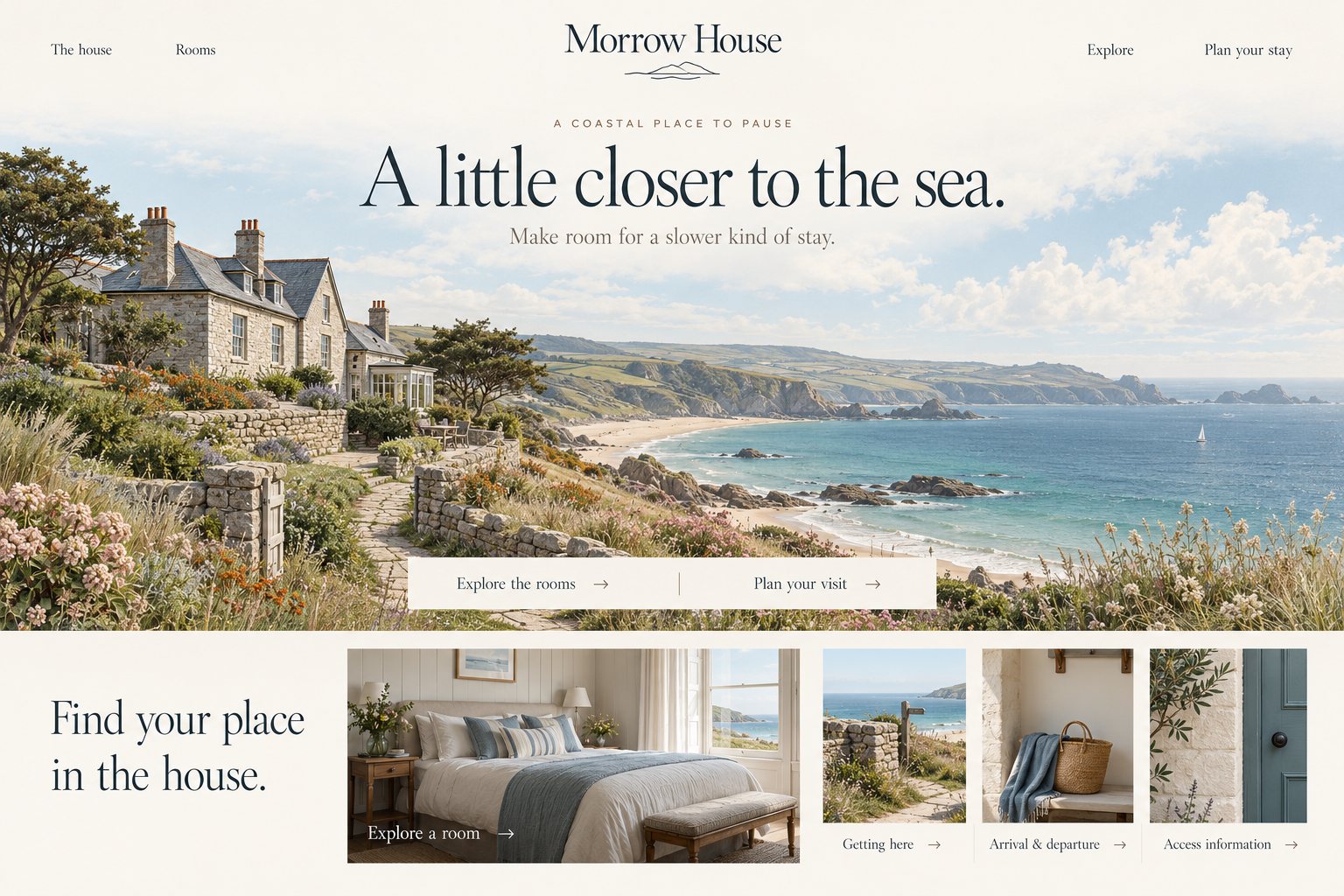
The supplied image deliberately leads with place. The next layer would need to supply the facts that make the invitation responsible and actionable.
- 01
A place, then a route
The coastal scene establishes character while two clear actions separate exploring rooms from planning a visit.
Check it: Ask a first-time visitor where they would start if they had fixed dates and a specific room requirement.
- 02
Rooms as comparable choices
The visible room section suggests a route to individual room details; a real version would align the facts people need to compare.
Check it: Give a two-person scenario and ask the guest to identify a suitable room and explain what remains unknown.
- 03
Arrival information close at hand
Getting here and access information belong in the decision, not only in an email after payment.
Check it: Ask someone travelling without a car to find enough information to decide whether the stay is practical.
Method behind these choices: How People Read Online: New and Old Findings (source, new tab).
03 / Behind the website
Research the whole stay, starting before the booking.
An enquiry or cancellation can reveal a misunderstanding that the website created days earlier. Discovery would connect those moments rather than optimise a booking button in isolation.
- Listen to real planning stories
Ask likely guests how they chose a recent stay, who else was involved and what made them hesitate. Avoid collecting unnecessary travel or personal details.
- Map information and operations
Compare room descriptions, policy text, booking records and arrival messages. Find contradictory facts and unclear ownership.
- Prototype the room decision
Use accurate sample policies and room facts in a simple comparison journey before connecting any booking provider.
- Test the difficult scenario
Include dates that are unavailable, a room that does not fit and a guest with a specific access question. A good journey explains limits as clearly as opportunities.
Three realistic tasks for a prototype
Find a suitable room
Choose a room for the supplied number of guests and a stated practical requirement.
Record correct understanding of capacity, facilities and unconfirmed assumptions.Understand the commitment
Explain the total shown price, cancellation conditions and what an enquiry actually reserves.
Record misunderstood fees or beliefs that a non-binding enquiry confirms a room.Plan the arrival
Find transport, arrival timing and a route for asking an access question.
Check factual retrieval rather than asking whether the page “looks welcoming”.
What would make this an honest evaluation?
Keep exploratory tourism browsing separate from people actively comparing dates. A striking hero image could increase browsing time while making a time-sensitive booking task slower.
Booking data would need a defined cancellation window and a consistent room-night denominator. Compare like seasons and account for price, inventory and acquisition changes before attributing any difference to design.
Research practice: Using moderated usability testing (source, new tab).
04 / Behind the website
Original words. A reason for every page.
Original hospitality copy should communicate the particular place and practical realities. A made-up destination description or unsupported accessibility promise would damage the very trust the design is trying to create.
| Question or search intent | Original page response | Evidence to gather first |
|---|---|---|
| “coastal stay with sea view” | A truthful place and room explanation with accurate photographs and the limits of each view. | The real property, location, room inventory and permissioned photography. |
| “how to reach [property] without a car” | A transport guide with current local information and a clear review date. | Verified routes, responsible reviewer and seasonal limitations. |
| “room cancellation policy” | Plain booking conditions accessible before a commitment. | Approved booking terms, provider rules and the actual refund process. |
Destination, room and planning pages would have different jobs rather than repeating the same romantic paragraph with new keywords. Structured data, if suitable, would reflect facts actually present on the page.
Search visibility is a discovery question, not an occupancy guarantee. The content plan would include ownership of changing details such as arrival instructions, policies and transport links.
Search phrases here are research seeds, not verified search volumes, rankings or traffic forecasts. Keyword research would validate demand, location, language and competition before publication.
05 / Behind the website
Make the assumptions visible.
The relevant unit is a room-night: one room sold for one night. This simplified model shows how occupancy and variable servicing cost interact without pretending a fictional coastal house has trading history.
Change the assumptions
Understand the room-night economics
Use the same monthly period for availability, occupancy and price.
Illustrative calculation · not a forecast
- Expected occupied room-nights
- 90
- Illustrative room revenue
- £14,400
- Revenue less stated variable cost
- £10,350
The arithmetic, openly shown
Occupied room-nights = available room-nights × occupancy ÷ 100Room revenue = occupied room-nights × average nightly priceContribution = occupied room-nights × (nightly price − variable cost)
This is not profit or an occupancy forecast. Fixed property costs, staffing, acquisition fees, tax, cancellations and any excluded servicing costs still matter. Price and occupancy are not assumed to vary independently in real life.
From an attractive calculation to a trustworthy decision
A room blocked for maintenance should not be silently counted as sellable inventory. Agree how availability and cancellations are recorded before publishing an occupancy comparison.
A higher nightly price can change demand and guest mix. Use the model to frame questions, then investigate the relationship with actual booking records and seasonal context rather than treating every input as a free improvement lever.
06 / Behind the website
Let the calm front connect to a reliable stay record.
A booking experience could use a specialist provider with a custom public interface and a private operational workspace. Research should determine what needs to be bespoke and what an established service already handles well.
- 01
Availability connection
Read room availability from an agreed source of truth and make the status of a request explicit.
Information in: Room inventory, dates and booking-provider responses.
Useful output: A checked availability result with clear failure handling. - 02
Guest preparation workspace
Organise authorised arrival preferences and unanswered practical questions.
Information in: Confirmed reservation and voluntarily supplied relevant details.
Useful output: A staff review queue with the information needed for the stay. - 03
Content and policy control
Keep room facts, arrival instructions and cancellation explanations in versioned records.
Information in: Approved property information and the current provider terms.
Useful output: Consistent pages and messages linked to a responsible owner. - 04
Operations handover
Create the appropriate preparation tasks when a reservation changes.
Information in: Confirmed arrival, departure and agreed operational requirements.
Useful output: Reviewable housekeeping or hosting tasks without exposing guest information publicly.
Permissions, human decisions and things that can go wrong
Access or health-related requests may be sensitive. Collect only what is needed, restrict access, set retention and provide a human contact for discussing requirements. A public page cannot infer suitability for every guest.
When availability cannot be checked, say so. Do not accept duplicate reservations, imply an enquiry holds a room or send an invented confirmation. Payment and booking state need a reliable provider-level reconciliation process.
Potential software only. These modules are not running behind the pictured website. Requirements, integrations, data protection, capacity, cost and support would be agreed before a real build.
07 / Behind the website
Evidence informs the idea. Testing earns confidence.
This accommodation concept concerns consumer travel choices. B2B purchasing percentages would not be a defensible booking benchmark; the transferable evidence here is about user research, information clarity and accessible interaction.
- Verify the property facts
A real operator would approve room capacity, photographs, access statements and booking terms.
- Measure completed understanding
Check whether guests can explain suitability and commitment, not simply whether they click a large image.
- Test operational failure
Try unavailable dates, provider downtime, booking amendments and a cancellation.
Read the sources and the limits of each one
Learning about users and their needs (source, new tab)
Investigate users’ goals, current approach and difficulties. Treat untested internal opinions as assumptions.
Scope: Public-service research guidance includes people who use, provide and support a service.
Limit: Transferable practice guidance, not a B2B revenue experiment or a claim that research has already been conducted for these concepts.
How People Read Online: New and Old Findings (source, new tab)
People commonly scan for information, with reading depth varying by task, motivation, focus and person.
Scope: The publisher summarises eyetracking research spanning 13 years, more than 500 participants and over 750 hours.
Limit: Reading is not always shallow and no single scanning pattern fits every page. This is not a measured sales uplift for these concepts.
Memory Recognition and Recall in User Interfaces (source, new tab)
Visible choices and contextual cues can support recognition instead of asking people to recall information unaided.
Scope: A cognitive-psychology explanation applied to menus, search and interface content; published January 2024.
Limit: A design heuristic, not proof of universal behaviour or a specific conversion increase. Labels still need testing with the intended audience.
Using moderated usability testing (source, new tab)
Observe actual or likely users attempting believable tasks to reveal language, navigation and interaction problems.
Scope: Guidance covers recruitment, neutral task instructions, consistent discussion guides and accessible sessions.
Limit: Small qualitative tests expose contextual problems; they do not establish population conversion rates or commercial causation.
Creating helpful, reliable, people-first content (source, new tab)
Create original, useful content for an intended audience, drawing on genuine knowledge and clear sourcing; apply SEO to help that content be discovered.
Scope: Google’s published content self-assessment guidance, including purpose, originality, accuracy and trust.
Limit: Guidance is not a ranking guarantee. Length, exaggerated claims and copied summaries do not substitute for useful information.
SEO Starter Guide (source, new tab)
Write useful original content, anticipate the words different readers search for, and connect related pages with descriptive links.
Scope: Official introductory guidance on content, discoverability, images, search titles, snippets and site organisation.
Limit: Google does not guarantee indexing or first place. Search snippets may come from page text rather than the meta description; keyword repetition is not a sound strategy.
Involving Users in Evaluating Web Accessibility (source, new tab)
Working with disabled users reveals practical barriers; combine it with standards-based accessibility evaluation.
Scope: Guidance covers user evaluation, assistive technology, reporting scope and cautious interpretation of small studies.
Limit: User testing alone does not establish WCAG conformance, and a few participants cannot represent every disability or access need.
Web Vitals (source, new tab)
The published good-experience thresholds are LCP at most 2.5 seconds, INP at most 200 milliseconds and CLS at most 0.1.
Scope: Assess the 75th percentile of real page loads, separately for mobile and desktop, across all three Core Web Vitals.
Limit: These are performance targets, not measured results for the concepts. A laboratory result is diagnostic and is not equivalent to representative field data or a sales forecast.
Your business would have its own starting point
Make the practical questions part of the welcome.
Darren can help frame a project around the questions a real guest asks before committing and the work the hosting team repeats afterwards.