
Research exhibit / Property development
Altura
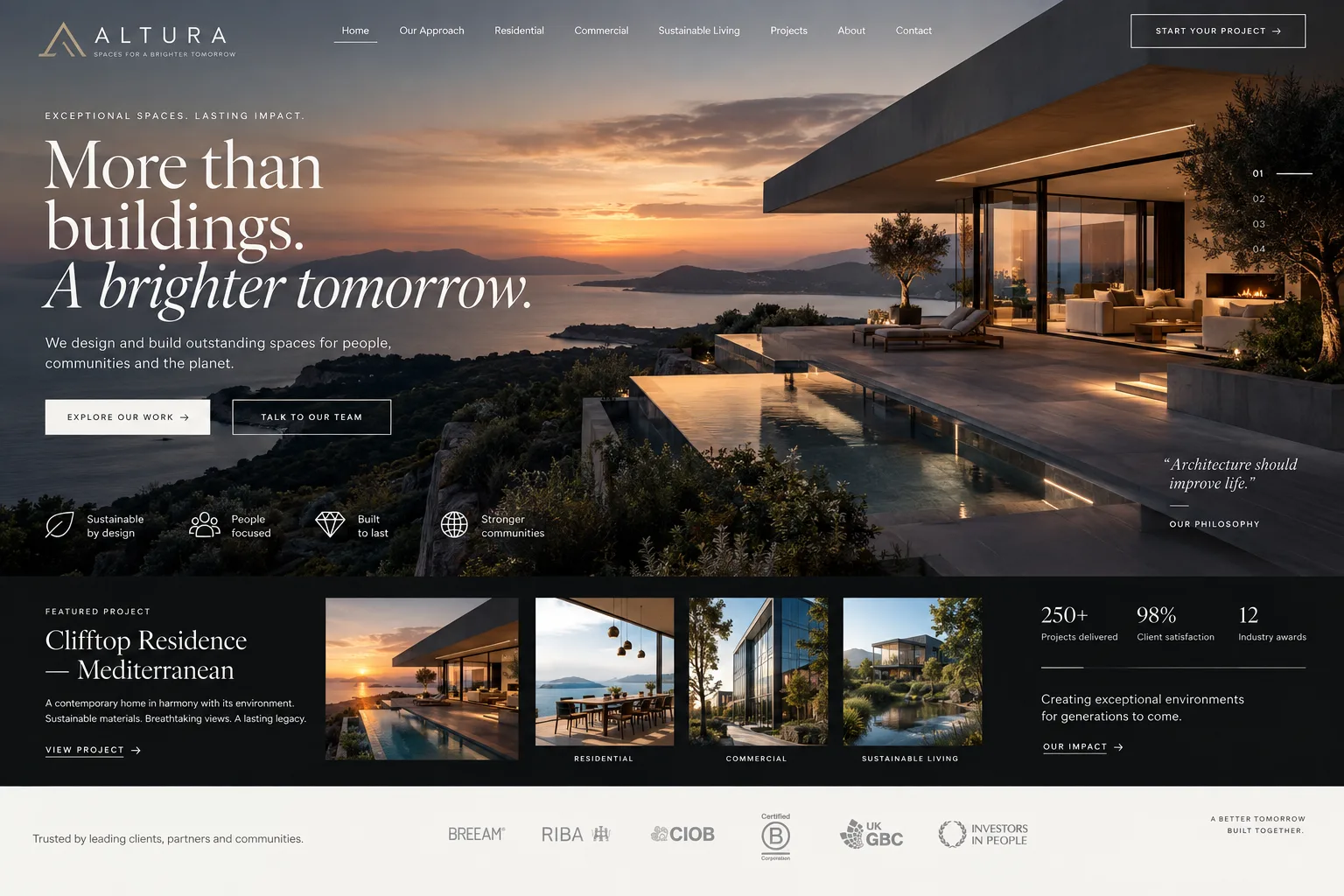
After a spectacular setting, which facts would convince someone to enquire about a development?
Beautiful property imagery cannot answer whether it fits.
A panoramic place can create interest while leaving availability, specification and location details unresolved. Buyers and partners need those concrete facts before a compelling scene becomes a relevant development enquiry.
Concept study · research not yet conducted. This is a specific investigation plan around an illustrative website. No interviews, verified search volumes, implemented software or measured outcomes are claimed.
The question shapes
the whole website.
This property development direction would be useful if the visitor can answer the study’s question and the receiving team can act on the resulting information. That remains a hypothesis to test.
The proposed website responseKeep the landscape as a memorable arrival, then introduce location, specification, availability and project evidence. Place a clear details request beside those facts so contact relates to an identifiable development rather than an unspecified image.
Who is choosing?
What is at stake?
A useful profile describes the job, concern and evidence behind a decision. These are hypotheses to investigate, not invented personas presented as facts.
- Profile hypothesis · not verified
Property enquirers
- The job
- After a spectacular setting, which facts would convince someone to enquire about a development?
- The worry
- A panoramic place can create interest while leaving availability, specification and location details unresolved. Buyers and partners need those concrete facts before a compelling scene becomes a relevant development enquiry.
- Proof to look for
- current availability, location facts, approved specifications and a clear status date
Find the right participants Invite people who currently perform this role and have a recent relevant decision to discuss. Include different experience and access needs.
Verify or reject Ask for a specific recent example, trace it against permitted records and retain disagreements as findings. Record source, role, date and research limitations. - Profile hypothesis · not verified
Development partners
- The job
- Join location, availability, suitability, viewing requirements and the owner of the next response.
- The worry
- Will the information be sufficient to judge a relevant property enquiry?
- Proof to look for
- current availability, location facts, approved specifications and a clear status date
Find the right participants Invite people who currently perform this role and have a recent relevant decision to discuss. Include different experience and access needs.
Verify or reject Ask for a specific recent example, trace it against permitted records and retain disagreements as findings. Record source, role, date and research limitations. - Profile hypothesis · not verified
Sales coordinators
- The job
- A project finder with concrete property facts and an enquiry tied to the selected development.
- The worry
- Can the receiving team act on the request without guessing missing facts?
- Proof to look for
- current availability, location facts, approved specifications and a clear status date
Find the right participants Invite people who currently perform this role and have a recent relevant decision to discuss. Include different experience and access needs.
Verify or reject Ask for a specific recent example, trace it against permitted records and retain disagreements as findings. Record source, role, date and research limitations.
Start with people
Explore which practical facts make a property or place worth enquiring about and how staff qualify an initial request.
The proposed record: A short list of audience needs, recurring questions and assumptions that still need checking.
Search for participants
Start with permitted enquiries and customer records, service-owner referrals and relevant professional communities. Recruit against the role and task, include different experience levels and keep an appropriate consent record.
Keep an evidence trail
Record participant criteria, research date, exact task, supporting observations and contradictory findings. An assumption is accepted, revised or rejected against what people actually do and say.
Follow one need
all the way through.
Every useful part of the page should have a reason. Follow the connection from a buyer’s situation to the evidence, original words, search answer and test.
One decision, traced from beginning to end
After a spectacular setting, which facts would convince someone to enquire about a development?
current availability, location facts, approved specifications and a clear status date
Look beyond the image. Check the details.
property development information
Show the location, current status, relevant specifications and practical conditions together. Help the enquirer understand what is known, what needs confirmation and which information belongs in the next conversation.
Can the buyer recognise whether the service covers their need?
One decision, traced from beginning to end
The buyer needs evidence relevant to a relevant property enquiry.
current availability, location facts, approved specifications and a clear status date
The conditions and evidence behind a relevant property enquiry
property availability enquiry
Before judging a relevant property enquiry, check current availability, location facts, approved specifications and a clear status date. Ask about the details that still need confirmation.
Can the buyer find the relevant constraints and supporting facts?
One decision, traced from beginning to end
The receiving team needs a usable handover.
Join location, availability, suitability, viewing requirements and the owner of the next response.
A useful brief for a relevant property enquiry
development project specifications
Prepare the information needed for a relevant property enquiry. The proposed receiving team would review the brief, identify missing facts and confirm the next step.
Can the buyer prepare the information the receiving team actually needs?
Follow the information
Join location, availability, suitability, viewing requirements and the owner of the next response.
The proposed record: One documented journey with required information, decision points and a named owner for each handover.
Find the words.
Check the intent.
Keywords are a research decision, not decoration. These case-specific candidates show why a term might belong, what page it needs and which evidence would confirm or reject it.
| Candidate and reasoning | Intent and page response | How to validate |
|---|---|---|
| property development informationA candidate phrase for the decision about a relevant property enquiry; investigate it with the people in this study, rather than choosing it for volume alone. | Understand the options Service overview and decision question | Compare buyer vocabulary, permitted search-query data, relevant search results and service-owner facts. Record contradictions. Search volume and ranking difficulty are not supplied.Project relevance |
| property availability enquiryA candidate phrase for the decision about a relevant property enquiry; investigate it with the people in this study, rather than choosing it for volume alone. | Check suitability Capability, evidence and constraints | Compare buyer vocabulary, permitted search-query data, relevant search results and service-owner facts. Record contradictions. Search volume and ranking difficulty are not supplied.Availability clarity |
| development project specificationsA candidate phrase for the decision about a relevant property enquiry; investigate it with the people in this study, rather than choosing it for volume alone. | Prepare the next action Process explanation and enquiry requirements | Compare buyer vocabulary, permitted search-query data, relevant search results and service-owner facts. Record contradictions. Search volume and ranking difficulty are not supplied.Enquiry routing |
Inspect the market
Review competing offers and alternative ways to solve the buyer’s problem. Record the public promises, qualifying details and unanswered questions. Investigate whether a gap matters to the buyer before making it the message.
Make the selection auditable
Keep the query source, intent, result-page review, target page, date and owner. Volume and competition remain unknown here. A real keyword tool estimate must include its tool, geography and period; first-party search data has its own coverage limits.
One question.
A proper, useful answer.
SEO helps people find a relevant page. AEO means structuring an answer people can understand and answer systems can interpret. Both begin with factual, specific content.
Editorial sketch · facts and wording still to verify
After a spectacular setting, which facts would convince someone to enquire about a development?
Show the location, current status, relevant specifications and practical conditions together. Help the enquirer understand what is known, what needs confirmation and which information belongs in the next conversation.
Search foundations
A distinct title, relevant heading, readable text, useful internal links and a page that can be crawled and indexed when publicly launched.
Answer structure
Place the direct answer beside the question, then show conditions, evidence, responsible ownership and the appropriate action.
Measure each channel
Use permitted query, impression, visit and enquiry data. Review available AI-citation reports separately. A citation, a visit and an enquiry are different events.
Google describes optimisation for its generative features as SEO; it does not require a special AI file or AI-only schema. Rankings, inclusion in answers and commercial results cannot be guaranteed. This password-protected preview supplies no live search-performance evidence.
Write this business.
From the beginning.
Every published sentence should earn its place by answering a buyer’s question or explaining a verified fact. The content is developed from scratch around this brief; a generic AI paragraph cannot supply client knowledge or evidence.
Gather the real material
Interview property buyers and project partners about the facts they seek after a first impression. Separate emotional attraction from the information needed to check suitability, and identify which project statements can be supported by approved records.
Look beyond the image. Check the details.
Show the location, current status, relevant specifications and practical conditions together. Help the enquirer understand what is known, what needs confirmation and which information belongs in the next conversation.
Approve the meaning
The owner reviews business facts and permissions; the research team checks the connection to the buyer question; likely users test whether the answer is usable. Unverified claims stay out.
- The buyer asks
- After a spectacular setting, which facts would convince someone to enquire about a development?
- The evidence required
- current availability, location facts, approved specifications and a clear status date
- Before it is published
- Trace each factual claim to an approved source, confirm permissions, check the meaning with the responsible owner and test comprehension with the intended audience.
The draft above is an illustrative content direction, not approved client copy. Original writing does not mean inventing facts. No claim is made that a buyer has approved these words.
Each part has a job.
Each job has a check.
This annotated blueprint shows the intended information hierarchy. It is a proposed content structure, not an eye-tracking heatmap or a measured analysis of the artwork.
Look beyond the image. Check the details.
After a spectacular setting, which facts would convince someone to enquire about a development?
Relevant facts and evidence
current availability, location facts, approved specifications and a clear status date
The process and its limits
Join location, availability, suitability, viewing requirements and the owner of the next response.
A useful request, with a clear next step
Development enquiry CRM
- A · Opening proposition
After a spectacular setting, which facts would convince someone to enquire about a development?
The page decision Show the relevant problem, the service category and the intended buyer before decorative detail.
Evidence to obtain Interview property buyers and project partners about the facts they seek after a first impression. Separate emotional attraction from the information needed to check suitability, and identify which project statements can be supported by approved records.
Check it Can the buyer recognise whether the service covers their need? - B · Capability and proof
What would help me judge a relevant property enquiry?
The page decision Keep the landscape as a memorable arrival, then introduce location, specification, availability and project evidence. Place a clear details request beside those facts so contact relates to an identifiable development rather than an unspecified image.
Evidence to obtain Request and review current availability, location facts, approved specifications and a clear status date.
Check it Can the buyer find the relevant constraints and supporting facts? - C · Process and boundaries
What happens, what is required and what remains uncertain?
The page decision Make the scope, dependencies and information needed for the next action visible in the page.
Evidence to obtain Join location, availability, suitability, viewing requirements and the owner of the next response.
Check it Ask the buyer to explain the process in their own words; note incorrect expectations. - D · Action and handover
What do I send and who takes it from here?
The page decision A project finder with concrete property facts and an enquiry tied to the selected development.
Evidence to obtain Attach each request to a relevant place, a contact history and a named follow-up owner.
Check it Choose a development for a supplied requirement and identify the facts still needed before arranging a viewing or discussion. Check the same essential path with keyboard navigation and relevant assistive technology.
Build a small testable route
A project finder with concrete property facts and an enquiry tied to the selected development.
The proposed record: A small public-facing route and a sketch of the associated staff task, ready to test with fictional records.
Visual hierarchy, recognition and scanning guide a design hypothesis. They do not read a buyer’s mind or prove a sales effect. Observe the actual task, including failures and access barriers.
The website starts it.
The working system carries it.
A well-designed enquiry can become useful information for the people doing the work. These are case-specific capabilities to scope, not a claim that the artwork hides a working backend.
- 01
Development enquiry CRM
Attach each request to a relevant place, a contact history and a named follow-up owner.
Website request or agreed record named staff owner review and next action visible status for authorised people. - 02
Availability publishing
Maintain approved property status in one record so public pages and staff use consistent information.
Approved source material editable draft or change human review publication through an agreed connection. - 03
Viewing coordination
Coordinate proposed appointments and reminders with the team’s agreed calendar connection.
Maintained dates or capacity proposed arrangement responsible-person confirmation recorded change and reminder.
These are possible bespoke backend features, not a view into an existing working system. Scope, data, permissions, integrations and staff responsibilities would be agreed after discovery.
Use safely fictional test records; agree access permissions, integrations, approval points and recovery behaviour before any production build.
Give a real task.
Watch what happens.
Set a believable goal, use neutral instructions and record success, confusion and failure. Observe likely buyers and receiving staff; include relevant accessibility checks.
Choose a development for a supplied requirement and identify the facts still needed before arranging a viewing or discussion. Check the same essential path with keyboard navigation and relevant assistive technology.
Observe a real task
Choose a development for a supplied requirement and identify the facts still needed before arranging a viewing or discussion. Check the same essential path with keyboard navigation and relevant assistive technology.
The proposed record: A record of task completion, misunderstandings and access barriers, with the scope and participants stated.
- Baseline to establish
Project relevance
Observe whether the selected place fits the stated requirement.
Record a baseline first. Compare similar tasks after a change, include failures and note other factors that may explain differences. No result is claimed here. - Baseline to establish
Availability clarity
Ask whether users can distinguish current information from indicative plans.
Record a baseline first. Compare similar tasks after a change, include failures and note other factors that may explain differences. No result is claimed here. - Baseline to establish
Enquiry routing
Record whether staff can route a request to the appropriate development and owner.
Record a baseline first. Compare similar tasks after a change, include failures and note other factors that may explain differences. No result is claimed here.
Record the conditions
Task wording, participant criteria, device, starting point, assistance, completion rule and failure reason all belong in the record. Agree them before observing the task.
Change one useful thing
Prioritise a clear barrier, make a specific revision and repeat a comparable task. Keep evidence that contradicts the hypothesis. Small usability samples reveal problems; they do not establish a population conversion rate.
The maths must match
the question.
A number becomes useful when its numerator, denominator, conditions and limitations are clear. These specifications connect the proposed measures to this case’s actual task.
Project relevance
Tasks meeting the agreed success criterion ÷ all attempted tasks × 100
- Unit
- Percentage of attempted tasks
- Collect
- State the success criterion first. Record successful, failed and assisted attempts; count every attempt in the denominator.
- Interpret
- Compare like-for-like tasks and report the counts as well as the percentage. A small sample does not establish a population conversion rate.
Availability clarity
Tasks meeting the agreed success criterion ÷ all attempted tasks × 100
- Unit
- Percentage of attempted tasks
- Collect
- State the success criterion first. Record successful, failed and assisted attempts; count every attempt in the denominator.
- Interpret
- Compare like-for-like tasks and report the counts as well as the percentage. A small sample does not establish a population conversion rate.
Enquiry routing
Tasks meeting the agreed success criterion ÷ all attempted tasks × 100
- Unit
- Percentage of attempted tasks
- Collect
- State the success criterion first. Record successful, failed and assisted attempts; count every attempt in the denominator.
- Interpret
- Compare like-for-like tasks and report the counts as well as the percentage. A small sample does not establish a population conversion rate.
Show the calculation(8 ÷ 12) × 100 = 66.7%
No measured resultOne fictional arithmetic example: eight completed tasks out of twelve attempts. This is not a baseline, result, uplift, conversion forecast or measurement of this website.
| Measure | Completed | Attempts | Rate |
|---|---|---|---|
| Task completion | 8 | 12 | 66.7% |
This arithmetic demonstrates a method; it is not an improvement, forecast, estimate of revenue or proof of causation. A commercial claim needs suitable real data, an appropriate comparison and enough observations for its purpose.
Improve in small increments
Agree a starting measure for project relevance, availability clarity, enquiry routing. Test the riskiest step first, change one clear problem, then repeat a comparable task; record other changes that could affect the comparison.
The proposed record: An agreed comparison, the next useful change and a note of what remains uncertain.
A proposed evaluation plan for an illustrative website study. No interviews, analytics results, user tests or customer outcomes are claimed for this concept.
The explanation is only useful
if the page works.
Set performance budgets, test relevant devices and check keyboard, zoom, labels and assistive technology. Build quality supports the task; a score alone does not show that a buyer can do it.
- Loading · LCP≤ 2.5 s
How quickly the main content appears.
- Responsiveness · INP≤ 200 ms
How promptly a page responds to interaction.
- Visual stability · CLS≤ 0.1
How much the layout unexpectedly shifts.
Published Core Web Vitals “good” thresholds at the 75th percentile of real visits, assessed separately for mobile and desktop. Proposed field targets, not measured scores for this concept. A lab test alone is not field evidence; user testing alone does not establish accessibility conformance.
What would persuade us
to keep or change it?
Research is useful when it changes a decision. This ledger connects the claims made in the brief to evidence that would support, refine or reject them.
| Claim to investigate | Evidence to gather | Decision rule |
|---|---|---|
| Buyer profile | Explore which practical facts make a property or place worth enquiring about and how staff qualify an initial request. | Use the profile only where the recorded examples support it; retain exceptions and unresolved assumptions. |
| Chosen phrase and intent | Compare the candidate phrases with buyer wording, permitted queries and relevant search results. | Record intent, source, date, suitable page and a reason to retain or reject each phrase. |
| Published content | Trace service statements to current availability, location facts, approved specifications and a clear status date. | Write the answer from scratch, record factual approvals and remove unsupported claims. |
| Proposed improvement | Choose a development for a supplied requirement and identify the facts still needed before arranging a viewing or discussion. Check the same essential path with keyboard navigation and relevant assistive technology. | Establish a baseline, count failed attempts and compare agreed tasks before claiming any improvement. |
This includes a consumer or public-service journey. B2B survey findings are not presented as evidence about its end users.
Read the 14 sources, their scope and their limits
- Learning about users and their needs (source, new tab)
Public-service research guidance
Investigate what people need to do, their current approach and the problems they experience; treat untested internal opinions as assumptions.
Guidance for government services, including people who use, provide or support them.
A transferable practice method, not a B2B commercial-outcome study.
- Creating an experience map (source, new tab)
Research synthesis and journey-mapping guidance
Combine observed user experiences to reveal stages, dependencies, pain points and handovers across a service.
Particularly relevant to journeys involving several events, people, teams or touchpoints.
The map must be grounded in research. A proposed diagram is not an observed customer journey.
- Making prototypes (source, new tab)
Design practice guidance
Explore and test alternative designs with a small prototype before committing to a full build.
Includes sketches and realistic interactive prototypes for desktop and mobile tasks.
A convincing prototype is not proof of production security, reliability, integration or business value.
- Using moderated usability testing (source, new tab)
Task-based usability research guidance
Observe likely users attempting believable tasks to uncover confusing language, layout and interaction.
Tasks should have a clear goal without revealing the answer; sessions require appropriate recruitment and a consistent discussion guide.
Small qualitative rounds reveal specific problems. They do not justify general population percentages or guaranteed conversion gains.
- Using performance data to improve your service (source, new tab)
Performance measurement guidance
Plan measurement from the beginning and combine task data with research to decide what to improve.
The government service metrics are accompanied by guidance to choose additional measures appropriate to each service.
Commercial projects need their own measures. A before-and-after change may have several causes and is not automatically causal evidence.
- Involving Users in Evaluating Web Accessibility (source, new tab)
Accessibility evaluation guidance
Testing with disabled users can reveal practical barriers; combine this with standards-based evaluation and report the review’s limits.
Covers early consultations, formal studies, assistive technology and cautious interpretation of limited samples.
One user’s experience does not represent every disability. User testing alone cannot establish WCAG conformance.
- Search Engine Optimization (SEO) Starter Guide (source, new tab)
Primary-source practice guidance
Create original, readable and well organised content; anticipate the different terms experienced and new readers may use; give related pages descriptive links and relevant images useful context.
Official introductory guidance for search discovery and presentation. Search systems can understand related language without every exact phrase being repeated.
No guaranteed ranking, indexing or snippet wording. Avoid keyword stuffing, arbitrary word counts and invented search volumes. Public discovery and search eligibility need their own checks; publication does not guarantee a ranking or AI citation.
- Influencing your title links in search results (source, new tab)
Primary-source practice guidance
Give each page a concise, descriptive and distinct title, avoiding repeated boilerplate and keyword stuffing.
Official guidance explains how Google selects search-result titles using several on-page and off-page sources.
A written title is a preference signal, not control over the exact displayed search title or a promised click-through rate.
- Creating helpful, reliable, people-first content (source, new tab)
Primary-source practice guidance
Google encourages original, useful, reliable content for an intended audience. Its current quality guidance discusses effort, originality, skill and factual accuracy, with clear attribution where appropriate.
Publisher self-assessment guidance. Google says SEO is useful when applied to people-first content rather than search-engine-first content.
This is not a universal content checklist that guarantees ranking or sales. E-E-A-T is not itself a specific ranking factor. Each word cannot be separately scientifically validated.
- Optimizing your website for generative AI features on Google Search (source, new tab)
Primary-source practice guidance
Google treats AEO/GEO work for its generative search experiences as SEO. It prioritises original, useful content and ordinary technical structure; special AI files, schema and content chunking are unnecessary.
Google Search. Eligibility includes indexing, snippet eligibility and current Search Console generative-feature inclusion settings.
No guaranteed indexing, citations, position, sales outcome or eligibility in other services.
- Introducing AI Performance in Bing Webmaster Tools Public Preview (source, new tab)
Primary-source practice guidance
Bing recommends clearer structure, evidence, expertise, accurate current information and consistent meaning across text and media. Its preview reporting shows citation activity across supported Microsoft AI experiences.
Bing, Microsoft Copilot and selected supported integrations. Citation counts and sampled grounding queries describe supported answer experiences.
The cited-page measures do not indicate ranking, authority, placement or sales. Readable answers and references do not guarantee inclusion in an AI response.
- How People Read Online: New and Old Findings (source, new tab)
Publisher’s synthesis of eyetracking research
People commonly scan online content while looking for relevant information. Reading patterns vary with layout, task, motivation and the individual.
Public summary of 13 years of eyetracking research, over 500 participants and more than 750 hours of observation.
Not every visitor scans all content, and no single layout pattern fits all pages. The public article does not establish a revenue increase for this project; the paid report was not accessed.
- Memory Recognition and Recall in User Interfaces (source, new tab)
Cognitive psychology and interface-design guidance
Visible choices and contextual cues can support recognition instead of asking people to recall information unaided.
A cognitive-psychology explanation applied to menus, search and interface content; published January 2024.
A design heuristic, not proof of universal behaviour or a specific conversion increase. Labels still need testing with the intended audience.
- Web Vitals (source, new tab)
Published web-performance measurement guidance
The published good-experience thresholds are LCP at most 2.5 seconds, INP at most 200 milliseconds and CLS at most 0.1.
Assess the 75th percentile of real page loads, separately for mobile and desktop, across all three Core Web Vitals.
These are performance targets, not measured results for the concepts. A laboratory result is diagnostic and is not equivalent to representative field data or a sales forecast.